
What Excavation Safety Really Looks Like on a Federal Job Site
“Safety” is one of those words every contractor puts on their website. It’s easy to say and hard to prove. So instead of telling you we’re safe, we’d rather show you what it actually looks like on a real job — and let someone else do the talking.
In late 2023 our crew finished a stretch of excavation work on the B1286 Steam Plant Project at Hill Air Force Base, just up the road from Clearfield and Layton. The work itself was straightforward for us: removing excess soil from inside an existing 2,900-square-foot structure, placing and compacting aggregate base course, and final grading for a new concrete slab footing. The part worth writing about wasn’t the dirt. It was how the job got done.
When we wrapped up, the general contractor — HHI Corporation — sent over a letter we didn’t ask for.
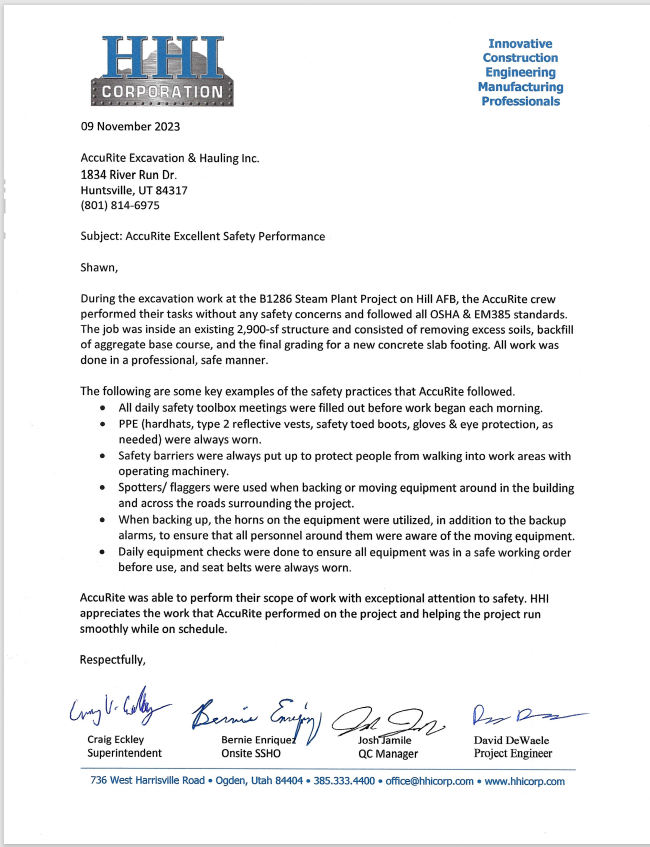
“During the excavation work at the B1286 Steam Plant Project on Hill AFB, the AccuRite crew performed their tasks without any safety concerns and followed all OSHA & EM385 standards.”
That second standard — EM385 — is the part most people outside of federal work have never heard of, and it’s worth a quick explanation.
OSHA and EM385, in plain English
Most construction in the country runs on OSHA rules — the federal workplace safety standards that cover things like trench protection, fall hazards, and personal protective equipment. Every excavation contractor should be working to those standards on every job, residential or commercial.
Federal and military projects add a second, stricter layer: EM 385-1-1, the safety manual published by the U.S. Army Corps of Engineers. It’s a thick book, and it goes further than OSHA in a lot of places — more documentation, tighter requirements, and a lower tolerance for “we’ll figure it out as we go.” When you work on a base like Hill AFB, you’re held to both. The letter above is HHI confirming we met that bar.
So what does meeting it actually look like on the ground? The letter spelled it out, and it’s a good window into how a job site should run whether it’s a military base or a basement dig in Ogden.
The unglamorous habits that keep people safe
Here’s what HHI pointed to specifically — and honestly, this is the stuff that matters on every job we do:
- A toolbox talk every single morning. Before anyone touched a machine, the crew filled out and walked through a daily safety meeting. Five minutes that set the tone for the day.
- PPE, every time, no exceptions. Hard hats, Type 2 reflective vests, steel-toed boots, gloves, and eye protection as needed. Not “when the inspector’s around” — always.
- Barriers around the work. Physical safety barriers kept people from wandering into active work areas where machines were moving.
- Spotters and flaggers. Any time equipment was backing up or moving through the building or across the surrounding roads, someone was on the ground directing it.
- Backup horns, not just alarms. When backing up, operators used the horn on top of the standard backup alarm — a second, louder signal so everyone nearby knew a machine was on the move.
- Daily equipment checks, seatbelts on. Every machine was inspected before use to make sure it was in safe working order, and seat belts were worn. Every day.
None of that is flashy. That’s the point. Safe job sites aren’t built on one heroic moment — they’re built on the same boring, disciplined habits repeated every morning until they’re automatic. After 30+ years, that’s just how our crews work.
Why this matters even if you’re not the Air Force
You might be a homeowner planning a basement excavation, or a general contractor prequalifying subcontractors for a commercial build. Either way, the same things protect you:
A contractor with safe habits is a contractor who finishes on schedule. Trench collapses, struck-by incidents, and utility strikes don’t just hurt people — they stop your project cold, drive up costs, and create liability that lands on everyone involved. The discipline that satisfies an Army Corps safety standard is the same discipline that keeps a residential job moving without an incident.
It’s also measurable. Our 0.91 EMOD rating — a workers’ comp number that compares our claims history against the industry average — sits 9% below the baseline. That’s not a single good year. It’s three decades of running job sites the way the HHI letter describes.
The takeaway
We’re proud of this letter, but not because it’s a trophy. It’s proof that when an independent general contractor and an onsite safety officer watched our crew work on a federal installation, what they saw was a team that takes the boring parts seriously.
If you’ve got a government or commercial project that needs an excavation contractor who’ll meet the standard — and document it — we’d be glad to talk.