
Steam Plant Excavation at Hill Air Force Base
Hill Air Force Base sits in the flatlands between Clearfield and Layton, and it is one of the largest Air Force installations in the country by land area. When a project came up for excavation work tied to a steam plant facility on base, we knew it would require a different level of coordination than a typical commercial utility job.
Steam plants are not simple. The infrastructure that distributes heat across a large installation involves buried steam lines, condensate return lines, and the mechanical room below grade where it all comes together. Our scope covered the excavation side: foundation work, utility trenching, and final grading.
Scope of Work
The foundation excavation required cutting to specified depths and dimensions, then shaping the subgrade to receive the structural slab system. On a project like this, the tolerances matter more than on a residential foundation. The mechanical systems that sit on that slab are heavy and precise, and the concrete pours that follow our excavation work are built to engineering specifications that assume consistent bearing conditions.
Utility trenching ran from the plant out to existing steam line networks across the installation. These were not shallow utility trenches. Steam distribution lines run at depth and require specific bedding material, backfill compaction standards, and documented testing before cover. We coordinated the trench routing with the installation’s civil engineering office and with the mechanical contractor who was installing the pipe.
Final grading around the facility handled drainage away from the building and tied the disturbed area back into the surrounding installation grades.
Getting Work Done on an Active Military Base
Hill AFB is a functioning installation, and work there happens inside a set of procedures that are non-negotiable. Access control is the starting point. Every crew member required base access credentials, and our equipment went through inspection at the gate on a daily basis. We kept a tight roster of personnel working on this project and kept the access process organized so we were not losing work time at the gate.
The other coordination challenge was working alongside other trades. A project of this type brings in mechanical contractors, electrical contractors, and the base’s own engineering staff at different phases. Excavation is usually the first work to happen, which means if our scheduling slips, it ripples through every trade behind us. We planned our phases around the overall project schedule and communicated any changes early.
Security restrictions on base also limited what equipment we could bring in and what areas we could access without escort. That planning happens before mobilization, not after.
Proximity to Clearfield and Layton
Hill AFB’s location makes it a natural fit for our operation. We are based in Ogden, and the Clearfield-Layton corridor is where we do a significant amount of our commercial and government excavation work. Familiarity with northern Utah’s soil conditions, the local permitting environment, and the area’s utility infrastructure all translated directly to this project.
The soils in the Davis County lowlands around the base run toward silty and clayey conditions, which affects compaction behavior and how backfill needs to be placed. Our crews know what to expect and bring the right approach from day one.
What Makes Government Utility Work Different
Underground utility work on a government installation is different from a subdivision or commercial development in a few specific ways.
Documentation requirements are more thorough. Compaction testing, material certifications, as-built drawings, and daily construction reports are all standard deliverables. The contracting structure also tends to involve more layers of review and approval before certain phases can proceed.
AccuRite holds the E100 General Engineering Contractor license that government utility work in Utah requires. Our 0.91 EMOD safety rating meets the prequalification thresholds that federal and military contracts demand. We have built the administrative processes to handle government project documentation without it slowing down our field work.
Recognized for Safety Performance
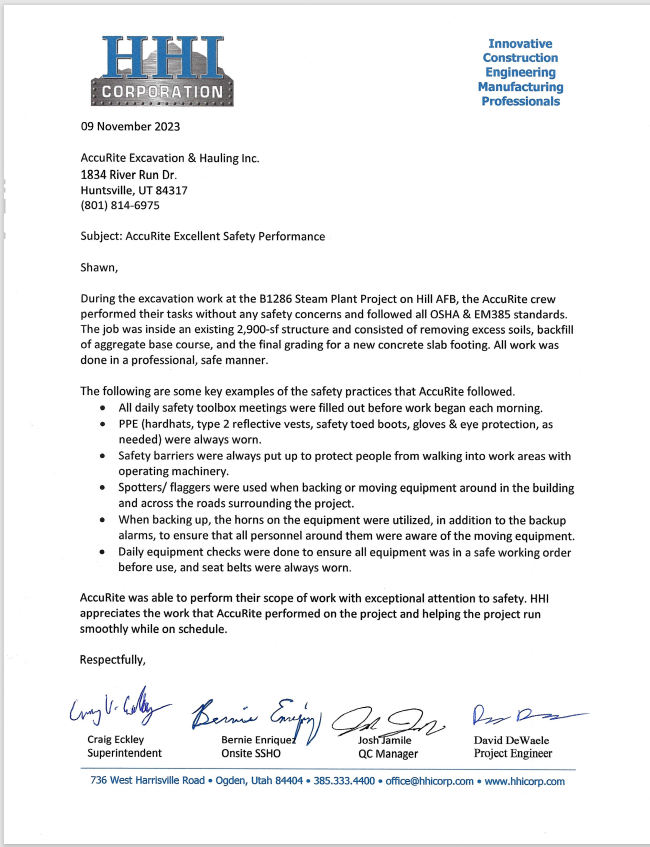
When we completed our excavation scope on the steam plant project, the general contractor — HHI Corporation — sent an unsolicited letter recognizing our crew’s safety performance, confirming the work followed both OSHA and EM385 standards (the stricter federal safety manual that applies on military installations). It was signed by HHI’s superintendent, onsite safety officer, QC manager, and project engineer.
We wrote more about what excavation safety actually looks like day to day — and what OSHA and EM385 require — in this companion post.
If you have a government or military project that needs excavation or utility work, reach out to our team.